The strongest faceless channels don't start with random clips. They start with a format you can repeat for a specific audience and a specific job. That matters even more now because faceless content is no longer a fringe tactic. A 2026 roundup reported that 38.4% of YouTube channels with more than 100,000 subscribers use a faceless production model, and those channels publish far more often than camera-led creators, which points to faceless video as a scalable operating model rather than a workaround for people who don't want to be on camera (faceless YouTube channel statistics).
When people ask for faceless video ideas, they usually want inspiration. What they need is a format choice. Trend-led concepts are built for reach. Evergreen education builds authority. Product-driven formats support conversion. Character-led series build recall and audience loyalty. If you don't know which lane you're in, you'll post a little of everything and learn almost nothing.
The better approach is simple. Pick one production model, match it to one growth purpose, and turn it into a repeatable short-form system. Each idea below includes a hook template, visual recipe, example prompt, and a clear fit for creators, agencies, or brands.
If you want more broad creative prompts beyond this list, this roundup of best video ideas for 2026 is a useful companion. And if you need help scaling, Hooked is one option for trend tracking, AI scripts, voiceovers, avatars, slideshows, and scheduling.
1. AI-Generated Voiceover and Text-to-Speech Videos
This is the cleanest starting point for most faceless operators. You write a strong script, pair it with synthetic narration, and build the visual layer from stock footage, screen recordings, motion text, or simple graphic scenes. It works best when the idea itself is useful enough to carry the video.
The production trade-off is obvious. You gain speed and consistency, but weak voice selection can make the content feel disposable. If the narration sounds generic, viewers assume the thinking is generic too.
Hook and build
Use a hook that promises clarity fast.
- Hook template: “If you're struggling with [problem], do this instead.”
- Visual recipe: 1 opening problem statement, 3 supporting scenes, 1 summary frame, full captions throughout.
- Example prompt: “Write a 30-second script explaining why new ecommerce brands waste money on broad targeting and what to test first.”
- Best fit: Creators building educational pages, agencies producing multilingual content, brands explaining products or processes.
A practical example is a personal finance page that explains one common mistake per video using animated captions, app screenshots, and market-related B-roll. Another is a SaaS brand turning onboarding friction into short how-to explainers.
What works and what doesn't
The format improves when you standardize the voice and visual pacing. Don't switch voices every week. Don't use unrelated stock clips just to fill space. Keep the visuals literal when the topic is complex.
Practical rule: If the audio could be swapped onto any niche and still make sense, the script is too generic.
For teams that want a production shortcut, Hooked's text-to-speech feature is relevant here because it supports voice-led faceless workflows without needing on-camera talent.
2. Trending Audio and Music Sync Videos
If you want fast reach without showing a face, this is one of the few formats that can produce volume and signal quickly. It is a distribution format first. The goal is to match a pattern viewers already accept, then attach your product, opinion, or niche angle to it before the trend cools off.
This production model works best for trend-led growth, not authority-building. Use it to test hooks, widen top-of-funnel reach, and spot which messages deserve an evergreen follow-up later. Skip it if your approval process takes a week or your brand cannot publish at trend speed. By then, the sound is usually old.
Benchmarketing analysts found that TikTok-native short video outperformed repurposed low-context clips, which is a useful reminder to edit for the platform instead of posting the same cut everywhere (short-form video benchmarks).
A repeatable trend-testing format
The reliable version is simple. Pick one trending sound, match it to one clear audience reaction, and build one payoff beat around the audio peak.
- Hook template: “POV: you finally found the fix for [specific pain point].”
- Visual recipe: Pattern-interrupt first frame, on-screen text timed to the beat, 4 to 7 clips, one reveal or payoff at the strongest audio moment.
- Example prompt: “Create a 20-second TikTok concept for a skincare brand using trending audio, with text-only storytelling focused on one ingredient benefit and one visual payoff.”
- Best fit: Creators posting daily, agencies running fast creative tests, ecommerce brands with a large library of product footage.
A practical example is a fitness coach pairing a trending sound with “3 things I stopped doing to lose my first 10 pounds,” using exercise clips, short text cards, and a final habit reveal on the beat drop. A skincare brand can run the same structure with texture shots, application clips, and a single claim like “why this serum replaced my 3-step routine.” The format is flexible, but the edit has to stay tight.
Production choices that actually matter
Audio-sync videos reward speed, but they still break if the creative is vague. The strongest versions make one idea obvious in the first second. The weakest versions chase a sound with no message underneath it.
Keep the text short. Show motion early. Cut every clip that does not add tension, contrast, or payoff. If the trend matters more than the niche insight, you may get views and still learn nothing useful for future content.
Practical rule: If the same edit could sell skincare, SaaS, and supplements with only one caption change, the concept is too generic.
For teams building around sound-first concepts, Hooked's audio-to-video workflow fits this model because it starts with the audio structure and lets you build the visual timing around it.
3. Educational Explainer Videos with Animated Text

If you want authority instead of a temporary spike, this is still one of the best faceless video ideas available. A good explainer gives viewers a reason to follow because they expect future videos to make hard topics easier to understand.
This format is less forgiving than quote pages or trend edits. Viewers will tolerate simple visuals, but they won't tolerate wandering logic. The script structure has to be tight.
A repeatable authority format
The easiest version is one problem, one explanation, one action step. Think “why your landing page isn't converting,” “what CPM tells you,” or “how creators pick hooks that survive the first second.”
- Hook template: “Many people get [topic] wrong because they ignore this.”
- Visual recipe: Headline card, animated keyword callouts, chart or screen recording, short recap frame.
- Example prompt: “Explain the difference between trend-led content and evergreen educational content in plain English for small business owners.”
- Best fit: Experts, consultants, B2B creators, agencies building trust before a sale.
A realistic scenario is an SEO consultant using screen recordings, keyword screenshots, and moving text to explain one search concept at a time. Another is a founder translating product strategy into simple visual lessons.
Keep the script teachable, not academic. If viewers need to replay line one to understand line two, the short is overloaded.
4. Motivational and Self-Help Quote Videos
This format looks easy because production is light. It's hard to grow with unless you add a clear point of view. Generic motivation blends into everything else.
The way to make it work is to narrow the emotional job. Don't post “success quotes” for everyone. Build for one identity, such as anxious founders, beginner runners, students with exam stress, or people rebuilding after burnout.
Emotional specificity wins
The strongest versions feel less like a wallpaper account and more like a belief system. A quote over mountain footage is forgettable. A short sequence that names a specific feeling, reframes it, and lands on a concise line can travel.
- Hook template: “Read this if you're about to quit [goal].”
- Visual recipe: Slow-moving B-roll, 3 to 5 short text cards, calm audio bed, final affirmation frame.
- Example prompt: “Write five affirmations for freelancers who feel inconsistent and distracted.”
- Best fit: Creators in mindset, wellness, fitness, faith, entrepreneurship, and coaching-adjacent niches.
A useful scenario is a running page that pairs difficult training clips with lines about discipline and recovery. Another is a founder-mindset channel that uses city footage, journaling visuals, and concise self-talk scripts.
The trade-off
This format is easy to batch and easy to publish. It's also easy to commoditize. If you choose it, treat it as a brand voice exercise, not just a quote feed.
- What works: Niche-specific affirmations, consistent visual tone, one recurring emotional angle.
- What fails: Overlong text blocks, generic stock visuals, recycled lines with no audience context.
5. UGC-Style Product Ads and Demo Videos

This is one of the most commercially useful faceless video ideas because it connects directly to buying behavior. You don't need a face if the hands, product, problem, and result are clear.
For brands and agencies, this is often more useful than broad lifestyle content. It gives you a modular ad unit you can rewrite, re-angle, and test across offers.
A conversion-first structure
Think in scenes, not in claims. Start with the pain point. Show the product entering the scene. Demonstrate the use. End with the outcome or one reason to act.
- Hook template: “I stopped using [old workaround] after trying this.”
- Visual recipe: Hands-only opening, close-up product detail, simple use demo, text overlay with one buying reason.
- Example prompt: “Write a 20-second UGC-style script for a desk gadget that reduces cable clutter in small workspaces.”
- Best fit: D2C brands, ecommerce stores, affiliate creators, paid social teams.
A simple example is a kitchen tool demo filmed top-down on a clean counter. Another is a software walkthrough where the creator records only the screen and narrates the problem-solution flow in a conversational voice.
What makes it believable
Most weak UGC-style faceless ads sound like ad copy pasted into a casual voice. That never feels authentic. Keep the language observational. Mention setup, friction, or a specific use case.
If you're building this at scale, Hooked's UGC ads workflow is relevant because the format depends on repeatable scripts and modular product scenes.
6. Trending Topic Compilations and News Roundup Videos
This format is high velocity and unforgiving. It works when you can collect, rank, cut, and publish quickly. It fails when the compilation adds no framing and becomes a repost with captions.
The best faceless roundup accounts aren't just clip aggregators. They act like editors. They tell viewers why each moment matters.
Use it for speed, not permanence
This is a strong choice for entertainment, pop culture, creator news, gaming moments, tech launches, and market reactions. It can also work in B2B if you narrow it, such as weekly ad creative shifts, AI tool updates, or platform changes.
- Hook template: “Three things everyone in [niche] is talking about today.”
- Visual recipe: Headline frame, clip one with label, clip two with context, clip three with takeaway, final opinion card.
- Example prompt: “Summarize three social media changes this week and explain what creators should care about.”
- Best fit: News pages, niche curators, agency social teams, creators who thrive on topical commentary.
Don't outsource the judgment. The clips can be sourced quickly, but the ranking and commentary are what make the account worth following.
Real trade-offs
You'll get freshness and frequency. You'll sacrifice shelf life. Most roundup videos have a short relevance window, so they work best alongside a second evergreen format.
This is also where workflow discipline matters. Save clips by niche, tag by topic, and keep intro and lower-third templates ready so you're not rebuilding the edit every time.
7. Niche-Specific Deep-Dive and Analysis Videos
Analysis videos build authority faster than trend recaps if the creator can make one sharp claim, support it, and stop. Short form rewards compression, not breadth.
The production model is simple. Start with a thesis, pull one proof point, add one comparison, then close with the consequence. That structure gives the video a real argument instead of a summary.
Use this format when the goal is trust, sales qualification, or category authority. Skip it if the account depends on daily volume, because analysis takes stronger judgment and better scripting than trend-led formats.
Here is the practical split:
For authority-building: explain why something in the niche works, fails, or gets misread. This fits consultants, operators, educators, and B2B founders who need viewers to trust their thinking.
For evergreen reach: answer a recurring question with a specific angle. This works for creators and brands that want search-friendly topics with longer shelf life.
For conversion: break down a mistake, bottleneck, or missed opportunity the audience already feels. Agencies and service businesses can turn these into quiet sales assets without making the video feel like a pitch.
A useful prompt is: “Explain why [common tactic] underperforms in [niche], show one example, and give one case where it still works.”
Hook templates that hold up:
- “Why [niche belief] sounds right but fails in practice.”
- “What [company, tactic, or trend] gets right, and what everyone copies poorly.”
- “If you work in [niche], watch for this before you copy [popular approach].”
Visuals matter more here than in quote or compilation formats. The easiest recipe is a bold opening claim on screen, then a chart, site teardown, document snippet, ad example, product screen recording, or annotated screenshot. Finish with one implications frame that tells the viewer what to do with the insight.
Best fit by operator:
- Creators: niche education series, commentary with a clear viewpoint, myth-vs-reality posts
- Agencies: ad teardown clips, landing page reviews, platform change analysis, creative strategy opinions
- Brands: product education, market category framing, objection handling, customer behavior insights
The common failure is scope creep. A 20-second analysis should answer one question. If the script needs three caveats, two examples, and a full history lesson, split it into a series and keep each post centered on one decision, one mistake, or one pattern.
8. AI Avatar and Custom Character Videos

Most brands adopt avatars for efficiency. The better reason is consistency. A recognizable character can hold together a series across languages, product lines, or daily publishing schedules.
This doesn't mean every account needs a digital host. In many niches, an avatar adds distance instead of trust. It works best when the character itself helps the idea.
When an avatar helps
A mascot-style explainer for a fintech app makes sense. A fictional coach delivering daily prompts can make sense. A faceless crime or history page using a cheerful cartoon host probably doesn't.
- Hook template: “[Character name] explains [confusing topic] in 20 seconds.”
- Visual recipe: Avatar intro, one expression shift, visual inserts for proof or examples, branded outro card.
- Example prompt: “Write a short script for a calm AI host explaining one beginner mistake in content strategy.”
- Best fit: Brands needing a recurring spokesperson, agencies localizing content, creators building story-led educational series.
If you're exploring visual identity options, this guide to AI avatars for social media is a useful external reference for concept direction.
A character is only memorable if it has constraints. Give it a tone, a role, and a narrow content lane.
The risk
Avatars can drift into uncanny or overly polished territory. When that happens, the content feels synthetic before viewers even process the message. Keep the movement simple and put most of the effort into script clarity and recurring character logic.
9. TikTok Slideshow and Carousel Conversion Videos
This is one of the most underrated faceless video ideas because it turns existing assets into a video publishing system. If you already have blog posts, product photos, customer screenshots, mood boards, or carousels, you already have source material.
It's not a lazy format when done well. The key is sequencing. A slideshow becomes watchable when each slide advances a narrative instead of acting like a disconnected deck.
Turn still assets into motion
Short-form video has expanded demand for concise formats across platforms. A 2026 roundup reported that short-form video takes 58% of social media time, and it also cited findings that consumers watch it regularly, which is exactly why slideshow-based production matters for teams that need speed without custom filming (short-form video statistics).
- Hook template: “Save this if you need a simple way to [result].”
- Visual recipe: 5 to 8 slides, one idea per card, subtle zooms or pans, optional voiceover, strong final CTA slide.
- Example prompt: “Turn a carousel about email subject line mistakes into a 25-second TikTok slideshow with one correction per slide.”
- Best fit: Ecommerce brands, agencies, educators, service businesses with lots of static assets.
A fashion brand can turn a lookbook into outfit logic. A design agency can turn before-and-after screenshots into a process breakdown. A local business can convert customer FAQs into swipe-style explainer videos.
What usually goes wrong
Too much text. Weak ordering. No payoff frame. The viewer should feel a build, even in a slideshow.
- Best practice: Open with the end benefit, then reveal the supporting points.
- Best practice: Use one visual style for each series so returning viewers recognize it instantly.
10. Competitor Analysis and Industry Insights Videos
This format attracts a higher-intent audience because the viewer usually wants to make a decision. They're comparing tools, stores, offers, campaigns, or market moves. That makes it especially strong for agencies, consultants, and brands selling to informed buyers.
It also forces discipline. You can't ramble through observations and call it analysis. You need a framework.
Use a recurring lens
Choose one comparison structure and keep it. For example, “hook, offer, proof, friction,” or “positioning, pricing, onboarding, retention.” Once the lens is stable, the series becomes much easier to produce and much easier to follow.
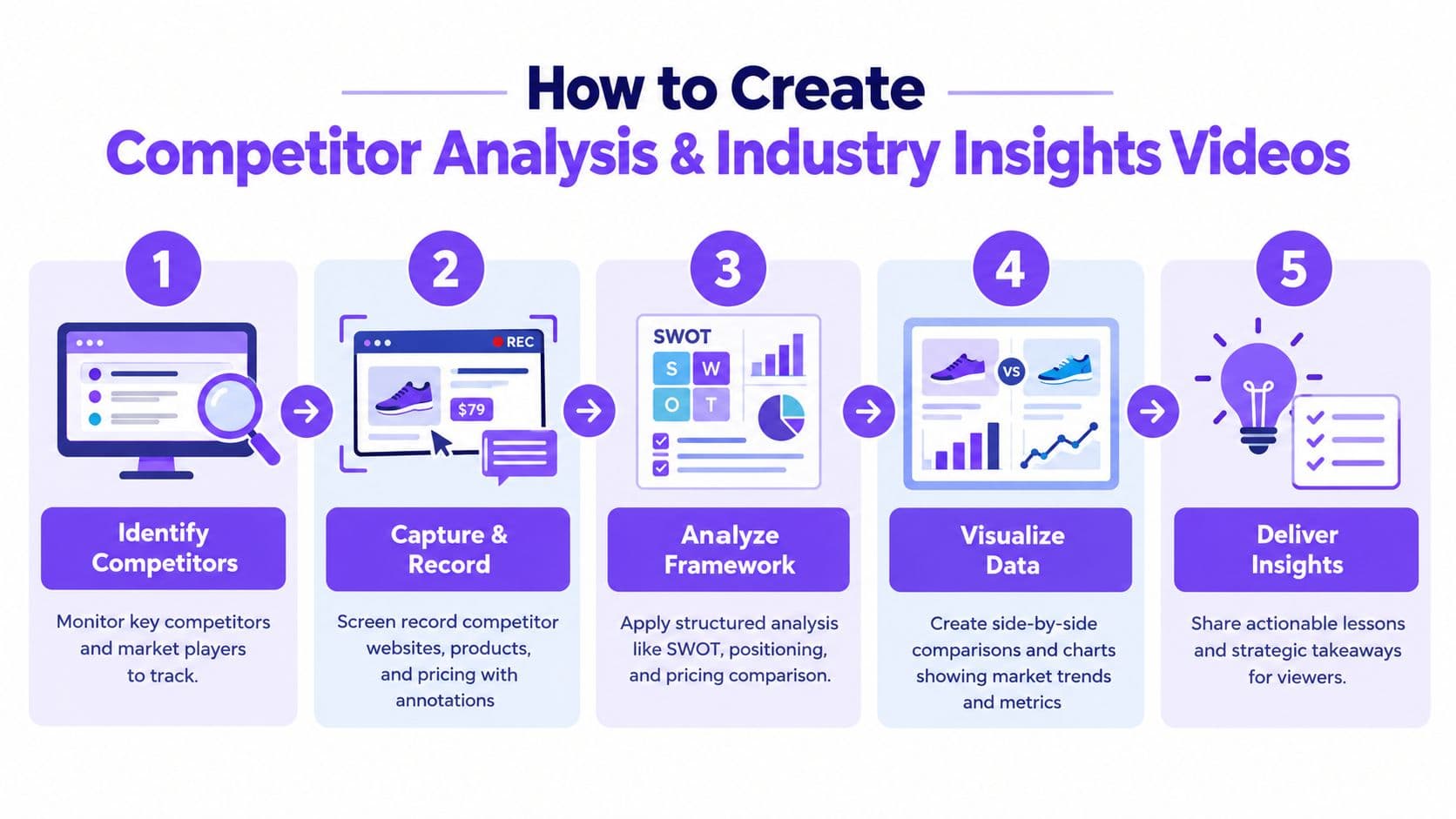
- Hook template: “Why does [brand or competitor type] convert better than everyone else in this category?”
- Visual recipe: Website or ad screenshots, labeled callouts, one comparison frame, one practical takeaway.
- Example prompt: “Break down two landing pages in the same niche and explain which one handles buyer objections better.”
- Best fit: Agencies, consultants, B2B brands, ecommerce operators, category educators.
Better than criticism
The strongest videos don't dunk on competitors. They extract lessons. A founder comparing two SaaS homepages can highlight pricing clarity. An ecommerce operator can compare product page structure. A media buyer can review ad angles by objection handling.
This category also pairs well with lead generation because the content naturally proves strategic thinking. If a prospect likes your breakdown, they already understand how you look at the market.
Faceless Video Ideas, 10-Point Comparison
| Title | Implementation Complexity 🔄 | Resource Requirements ⚡ | Expected Outcomes ⭐📊 | Ideal Use Cases | Key Advantages 💡 |
|---|---|---|---|---|---|
| AI-Generated Voiceover & Text-to-Speech Videos | Low–Medium, setup for voices & sync 🔄 | Low, AI voices, scripts, graphics; no recording gear ⚡ | ⭐⭐⭐⭐, scalable multilingual reach; 📊 consistent volume & low cost | D2C/ecommerce, agencies, global teams | Fast production; brand voice consistency; cost-effective |
| Trending Audio & Music Sync Videos | Low, trend curation & sync 🔄 | Low, trend tracking, templates, quick edits ⚡ | ⭐⭐⭐, high short-term engagement; 📊 bursty virality | Trend-focused creators, agencies, product tests | Algorithm boost; minimal creative effort; cross-platform reach |
| Educational Explainer Videos with Animated Text | Medium, motion design & research 🔄🔄 | Medium, research, motion graphics, editing time | ⭐⭐⭐⭐, high retention & SEO; 📊 long-term evergreen value | SaaS, educational institutions, agencies educating clients | Builds authority; repurposable into courses/guides |
| Motivational & Self-Help Quote Videos | Low, template-driven production 🔄 | Low, text assets, visuals, ambient music ⚡ | ⭐⭐⭐, very high engagement/shareability; 📊 rapid follower growth | Coaching brands, faceless channels, affiliate marketers | Easy bulk production; strong community engagement |
| UGC-Style Product Ads & Demo Videos | Medium, filming B‑roll & testimonial style edits 🔄🔄 | Medium, product footage, close-ups, scripts, voiceovers | ⭐⭐⭐⭐, higher conversions; 📊 strong ad performance | D2C brands, performance agencies, small businesses | Authentic-feeling ads; scalable; conversion-focused |
| Trending Topic Compilations & News Roundup Videos | Medium, rapid turnaround and curation 🔄🔄 | Low–Medium, curation, editing, rights checks | ⭐⭐⭐, high viral potential short-term; 📊 fast traffic spikes | News aggregators, high-volume faceless channels, culture creators | Real-time relevance; quick-to-publish once curated |
| Niche-Specific Deep-Dive & Analysis Videos | High, deep research and structuring 🔄🔄🔄 | High, subject experts, data viz, longer editing | ⭐⭐⭐⭐, subscriber loyalty; 📊 higher CPMs & monetization | Agencies, SaaS/fintech, thought leaders | Establishes credibility; strong long-term monetization |
| AI Avatar & Custom Character Videos | High, avatar creation & lip‑sync tuning 🔄🔄🔄 | Medium–High, avatar design, customization, voice cloning | ⭐⭐⭐, distinctive persona; 📊 repeat viewership potential | Brands with series, educational mascots, differentiating agencies | Unique brand character; high production value without live shoots |
| TikTok Slideshow & Carousel Conversion Videos | Low, convert images to slideshows 🔄 | Low, existing images, templates, voice/music sync ⚡ | ⭐⭐⭐, fast conversions from assets; 📊 efficient repurposing | Ecommerce catalogs, fashion/lookbooks, agencies | Repurposes existing assets; very fast and low-cost |
| Competitor Analysis & Industry Insights Videos | High, structured analysis & sourcing 🔄🔄🔄 | High, market research, screen recordings, data tools | ⭐⭐⭐⭐, engaged business audience; 📊 drives qualified leads/sponsorships | Consultants, B2B SaaS, digital agencies | Positions creator as authority; strong B2B monetization paths |
Turn One Idea Into a Repeatable Series
They don't need more faceless video ideas. They need fewer choices and better repetition. Start with one audience, one production model, and one measurable goal. If you skip that and chase novelty, every video becomes a fresh experiment and none of them become a system.
A practical way to choose is by growth purpose. If you need reach, test a trend-led format like audio sync videos or topical roundups. If you need authority, build around explainers, analysis, or niche deep dives. If you need conversion, prioritize UGC-style demos or slideshow videos built from existing assets. Those categories do different jobs, so don't judge them by the same outcome.
The production model matters just as much as the creative angle. Voiceover and text-to-speech formats are efficient when the insight is strong. Avatar-led content helps when brand consistency matters more than personal presence. Hands-only demos work when the product experience is the story. Slideshows work when the raw material already exists and the bottleneck is speed.
One useful benchmark for choosing format length comes from a 2026 analysis of more than 6 million TikTok videos, which found that 15 to 30 second videos produced the highest engagement rate, while 120 to 180 second videos drove the highest median views, giving faceless operators a practical split between shorter interaction-focused edits and longer cuts built for watch time (TikTok video length benchmark). Use that as an editing decision, not as a universal rule. A product ad may need brevity. An analysis video may need more room to land the point.
The workflow is straightforward. Identify the audience problem. Write three hooks for the same idea. Produce several visual variations instead of one perfect cut. Publish consistently. Review what held attention or drove action. Then keep the strongest format and drop the rest.
That's the shift. Treat each concept as a publishing system, not a one-off post. A repeatable series teaches you faster than random creativity ever will.
If you want help turning that into an operating rhythm, tools like Hooked can support the process with a daily roadmap, analytics, an AI Video Builder, and scheduling. The useful part isn't just faster production. It's having a tighter loop between idea selection, creation, publishing, and review.
For more planning inspiration around sustainable output, this guide on how to create consistent TikTok content easily pairs well with the formats above.
Hooked is built for exactly this kind of faceless workflow. You can track trends, generate scripts, create voice-led or slideshow-style videos, and schedule content from one place. If you want to turn a few promising faceless video ideas into a repeatable publishing system, visit Hooked.