A competitor's move rarely arrives as a single dramatic announcement. More often, it appears as a new creator partnership, a different product promise in short-form videos, a revised pricing page, or a cluster of customer complaints. By the time those fragments look obvious in a quarterly report, your team may already be reacting instead of deciding.
Competitive intelligence monitoring is the continuous practice of collecting, filtering, and interpreting competitor and market signals so teams can make informed decisions earlier. It isn't a dashboard exercise. Done well, it turns external noise into small, addressable choices for product, content, sales, and growth teams that need to ship every week.
Why Competitive Intelligence Monitoring Matters More Than Ever
A mid-market brand discovers that a competitor has repositioned around a niche both companies serve. The rival has spent weeks publishing creator-led videos for that audience, adjusting its landing pages, and buying the brand's own search terms. Nothing looked urgent in isolation. Together, the signals reveal a coordinated attempt to own the category conversation.
The brand's problem isn't a lack of information. It has social dashboards, search reports, sales notes, and a folder of competitor screenshots. The problem is that nobody connected those observations while the shift was still manageable. A useful monitoring program would have shown the change as a developing narrative, not as a collection of unrelated alerts.
Practical rule: Monitor for decisions, not for mentions.
One-off market research answers a defined question at a particular moment. Competitive intelligence monitoring keeps asking whether the conditions behind that answer have changed. Generic social listening usually counts or classifies mentions of a brand. Competitive monitoring goes further by examining what rivals are publishing, who they're targeting, which messages are gaining attention, and how quickly those narratives are spreading.
That distinction matters especially for social-first teams. A content lead may need to decide whether a competitor's new hook deserves a response, whether a creator format should enter next week's brief, or whether a product claim is becoming common across the category. Tools such as Hooked's trend monitoring resources can help teams observe emerging content patterns, but observation only becomes intelligence when someone interprets the pattern and assigns an action.
The practical promise is simple. A strong system creates a steady flow of signals that product, content, and growth teams can review, prioritize, and act on before a competitor's move becomes difficult to counter.
The Short History of Competitive Intelligence as a Discipline
Competitive intelligence has older roots, but it became a distinct business discipline in the United States during the 1970s, according to the history of competitive intelligence. Michael Porter's Competitive Strategy, published in 1980, gave executives a structured way to examine industries and competitors. The emphasis was largely periodic and strategic, useful for understanding rivalry, suppliers, buyers, substitutes, and barriers to entry.
Leonard Fuld's dedicated competitor intelligence book in 1985 helped formalize the field, while Ben and Tamar Gilad published the first organizational model for a formal corporate competitive intelligence function in 1988. Those milestones established an important principle: intelligence needed an owner, a method, and a connection to management decisions.

The widening field of observation
As business intelligence and web access matured, teams could examine competitor websites, product pages, pricing, job postings, patents, and public announcements more consistently. Web crawlers shifted the work from occasional manual checks toward repeatable observation, even though analysts still had to decide which changes mattered.
Social platforms changed the signal itself. Competitor strategy could now surface through executive commentary, customer discussions, influencer relationships, and platform-native content before it appeared in formal corporate communications. Monitoring had to absorb not only what a company said, but also how audiences responded and which messages traveled.
The creator economy widened the field again. A competitor's most important positioning may live in a TikTok hook, a YouTube Short, a sponsored creator brief, or a recurring visual format rather than a press release. Modern competitive intelligence monitoring therefore combines the discipline's original strategic lens with continuous, cross-channel observation.
Each expansion added complexity. The answer isn't to collect everything. It's to preserve the analytical question behind the system: what is changing, why might it matter, and which decision should change because of it?
How a Modern Monitoring System Actually Works
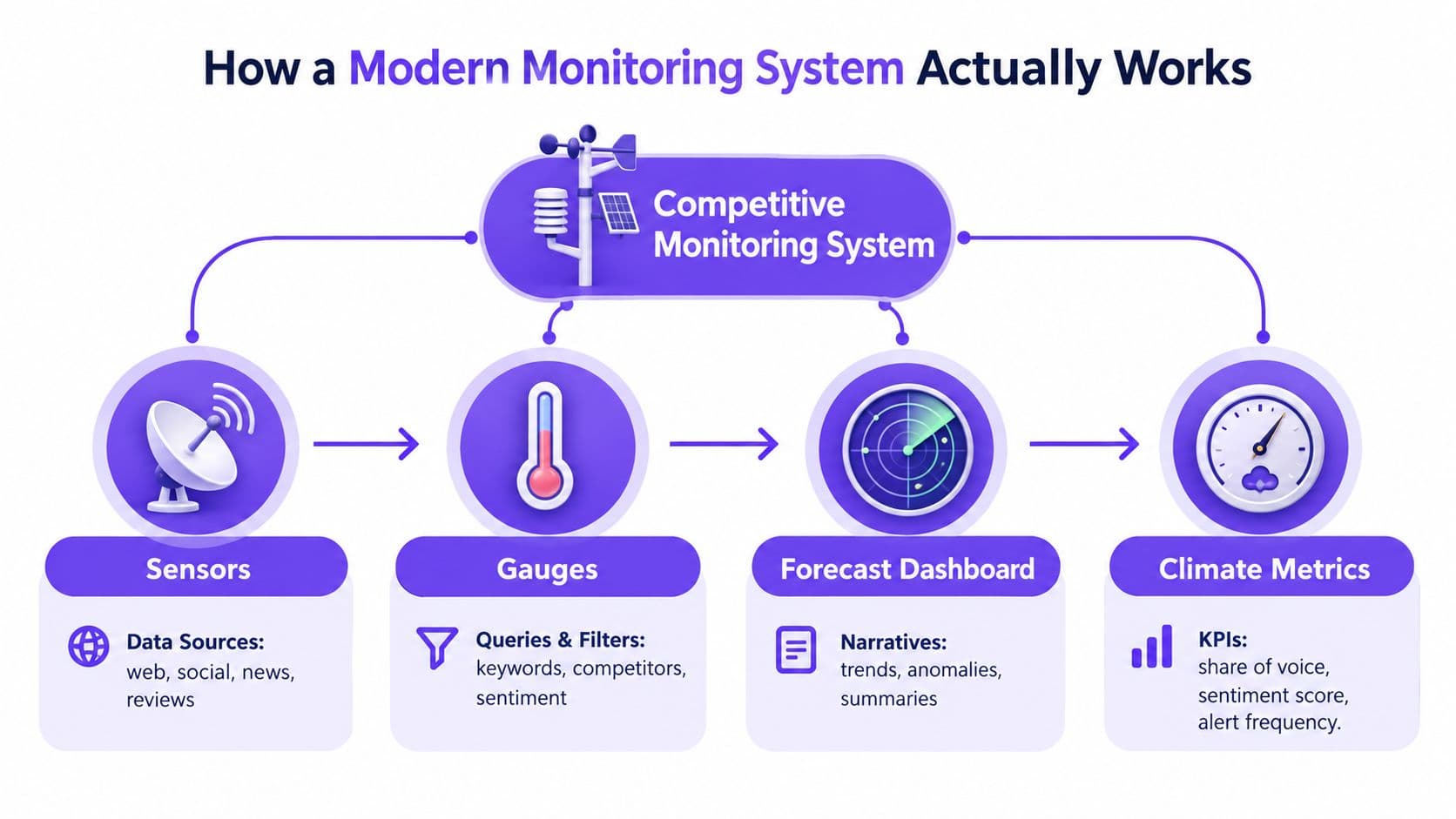
Think of a monitoring system as a weather station. Sensors collect conditions from different places. Gauges measure specific changes. A forecast model turns those readings into an interpretation. Warnings appear only when the conditions justify action.
Start with the sensors
Your sources should reflect the decisions you need to make. A practical stack may include:
- Owned competitor channels: Websites, product pages, blogs, release notes, newsletters, and official social accounts reveal published positioning and product priorities.
- Audience surfaces: Reviews, forums, Reddit discussions, comments, and community posts show how buyers describe strengths, weaknesses, and alternatives.
- Paid and search channels: Ad libraries, search results, landing pages, and SEO content expose the claims competitors are actively testing.
- Business signals: Earnings calls, hiring pages, partnerships, and executive commentary can point to strategic direction.
- Creator activity: Sponsorships, recurring formats, short-form hooks, and creator collaborations show how a competitor translates its positioning into culture and content.
Practitioner guidance recommends tracking competitor brands, category keywords, and executive names, rather than brand names alone. The B2B social listening guidance from Oktopost also frames benchmarking around engagement, reach, follower count, posting frequency, and share of voice.
Build gauges that filter for meaning
A query shouldn't only ask whether a competitor was mentioned. It should distinguish the competitor, product, category, executive, audience, and relevant theme. Start with brand and product names, then add buyer language, competitor comparisons, feature terms, pain points, and the names of visible leaders.
Filters should remove routine repetition and isolate meaningful movement. A new post may be ordinary. A new post that introduces a repeated claim, appears across several channels, and attracts unusual audience discussion deserves review.
Add the forecast layer
Narrative analysis groups scattered observations into a coherent story. It might connect a hiring theme, a new landing page, a creator campaign, and a shift in executive language into a hypothesis that the competitor is moving toward an enterprise audience.
guidance on choosing a social media monitoring tool for ads can be useful, especially when paid creative and organic conversation need to be viewed together. The tool gathers evidence. Your team still needs to decide whether the evidence supports a strategic conclusion.
Define the warnings
KPIs determine which signals deserve escalation. Depending on your business, those may include share of voice, sentiment movement, engagement, competitor-comparison conversion, branded search activity, or the adoption of a message across priority channels. A warning should always answer: who needs to know, what decision is available, and by when?
From Raw Signals to Decisions That Move the Business
Raw monitoring underperforms because collection is visible while interpretation is hidden. Teams celebrate a full feed of alerts, then discover that nobody knows which item should change the roadmap, content calendar, or campaign plan.
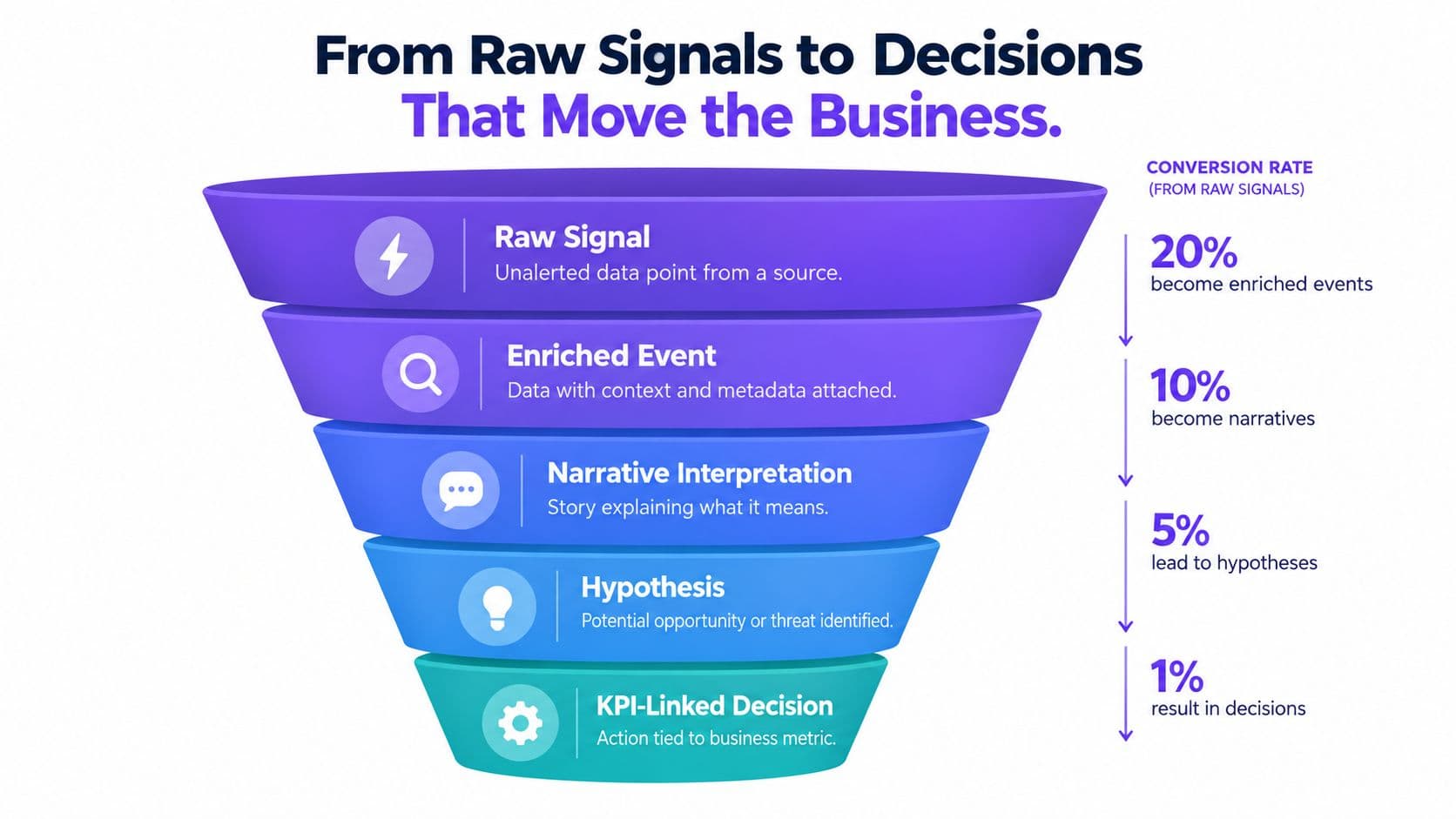
The conversion chain should be explicit:
- Raw signal: A competitor changes a pricing page, publishes a new ad, or appears with a creator.
- Enriched event: Someone records the date, source, competitor, product, audience, channel, and what changed.
- Narrative interpretation: The team explains the likely meaning. A pricing change may indicate packaging experimentation. A creator partnership may signal a new audience strategy. A sentiment shift may expose a weakness buyers are discussing.
- Hypothesis: The team states a testable possibility, such as, “This competitor is trying to own the workflow category with a simpler promise.”
- KPI-linked decision: An owner chooses an action tied to a metric, such as revising a comparison page, testing a counter-message, or prioritizing a product response.
The same raw input can produce different decisions depending on context. A new creator video might be irrelevant if it repeats an established format. It might matter if the creator reaches a new audience, uses a new promise, and appears alongside a broader change in the competitor's campaign language.
Measure decision quality, not alert volume
Every signal doesn't need a response. The system should reward useful prioritization, not constant activity. A weekly review can ask whether an alert changed a brief, influenced a product discussion, informed a sales enablement update, or prompted a test.
The Global Market and Competitive Intelligence Report highlights the gap between collecting intelligence and building strategic analysis capacity. It reports that world-class teams emphasize strategic analysis at 100% versus 48% for average teams, and that 78% versus 20% measure intelligence ROI. Those figures point to the central operating question: which signal changed a business decision, and how can the team prove it?
Monitoring Across Social, Creator, and Short-Form Video Channels
Traditional monitoring and social monitoring answer different questions. A website change or earnings call can reveal durable positioning, investment priorities, and commercial direction. A short-form video trend can reveal what a competitor is testing with an audience right now, but its relevance may depend on context, platform, creator, and format.
| Dimension | Traditional Web & Earnings | Social, Creator & Short-Form Video |
|---|---|---|
| Signal character | Slow, durable, structural | Fast, volatile, narrative-driven |
| Typical sources | Websites, pricing pages, filings, earnings calls | TikTok, Shorts, creator posts, comments, forums |
| Useful questions | What is the company investing in? How is it positioning the offer? | Which hook, format, creator, or message is gaining traction? |
| Review style | Periodic deep analysis | Continuous scanning with frequent lightweight review |
| Main risk | Missing a gradual strategic shift | Mistaking a temporary spike for durable momentum |
A traditional source may tell you that a competitor is moving upmarket. Creator content may show how that strategy is being expressed through testimonials, tutorials, or authority-led videos. Neither surface is sufficient on its own. Your monitoring design needs to connect structural evidence with audience behavior.
Match cadence to channel behavior
Social-first teams need continuous monitoring because narratives can emerge, mutate, and fade quickly. Recent guidance recommends continuous social competitive analysis, supported by lightweight monthly check-ins and real-time flags for posting-frequency changes or engagement spikes. The overview of social media trends in AI offers additional context for teams assessing how technology is changing social workflows.
For TikTok and similar channels, track more than account activity. Watch recurring hooks, visual structures, sounds, creator relationships, comment themes, posting patterns, and the audience language surrounding the content. A trend dashboard such as TikTok trend monitoring can support discovery, but a strategist must still decide whether the pattern fits the brand, audience, and objective.
The right question isn't “Which channel should we monitor?” It's “Which signal can answer the decision in front of us?” Use traditional monitoring for durable strategic shifts and social or creator monitoring for fast-moving narrative and creative signals.
A Weekly Operating Workflow for Continuous Monitoring
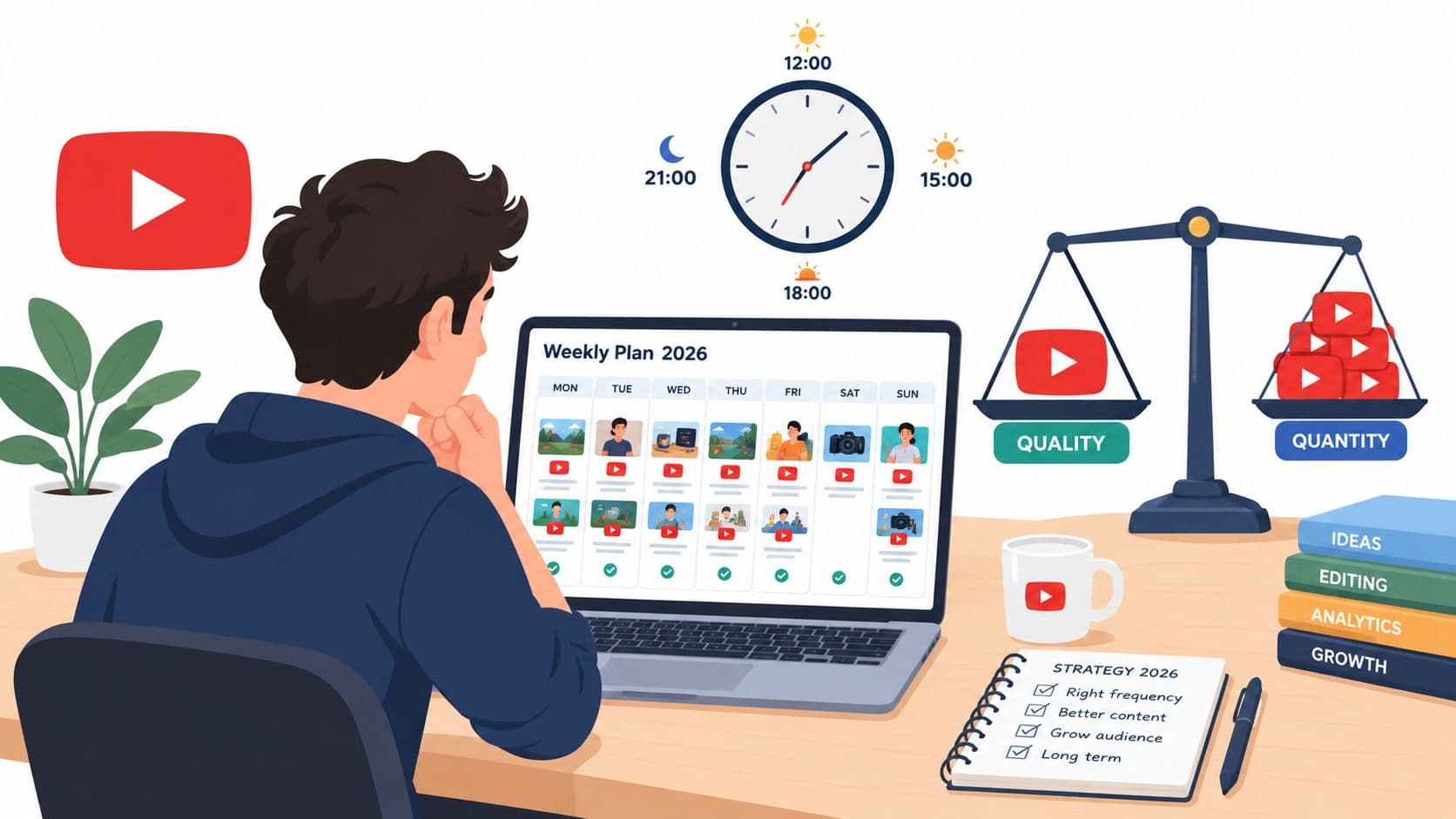
Continuous doesn't mean every team member spends every day staring at dashboards. A small team can run a clear weekly loop with separate gates for collection, analysis, and action.

Monday establishes the baseline
Refresh the competitor shortlist and remove accounts or sources that repeatedly produce noise. Confirm that queries still match the category language buyers use, then check whether new products, executives, creators, or channels should be added.
The Monday gate is simple: no analysis without reliable collection. If a source has stopped updating or a query produces irrelevant results, fix the input before asking the team to interpret the output.
Tuesday and Wednesday create context
Collect signals across web, social, review, paid, search, and creator surfaces. Tag each item by competitor, audience, channel, theme, and type of movement. Store the source and date with the observation so another person can verify it later.
Avoid writing conclusions at this stage. A new ad is an observation. “The competitor is shifting its entire growth strategy” is an interpretation that needs supporting evidence.
Thursday turns evidence into hypotheses
Hold a synthesis meeting focused on patterns, not individual alerts. Group related events and ask what changed, who appears to be the target, whether the behavior is new, and which business risk or opportunity it creates.
Write two or three concise hypotheses for the coming week, each linked to a KPI and an owner. One hypothesis might go to content, another to product marketing, and a third to paid acquisition. If no one can name a possible action, the item stays in the intelligence log instead of entering the priority queue.
Friday routes decisions
Send approved hypotheses into the relevant backlog with an owner and deadline. The content team may turn a positioning shift into a brief. Product marketing may update a comparison page. Growth may test a new message against an existing campaign.
Log what the team decided, what evidence supported it, and what result would confirm or reject the hypothesis. The disciplined loop compounds because each week improves the next query and baseline. Ad-hoc monitoring resets whenever someone remembers to check it.
Wiring CI Monitoring Into Content Strategy With Hooked
Competitive intelligence becomes useful when its signals reach the content calendar, campaign brief, and production queue. A report stored in a shared folder can be accurate and still arrive too late to affect the next decision.
Start with a focused watchlist of competitor accounts. Build narrative queries around their content pillars, audience segments, hooks, formats, offers, and creator relationships. The purpose is not to archive every post. It is to detect changes in how competitors attract attention, explain value, and participate in conversations across social, short-form video, and creator channels.
A practical operating sequence is:
- Choose a focused competitor set: Track accounts competing for your audience, creative territory, or paid demand.
- Define narrative queries: Organize observations by themes such as education, proof, price, convenience, identity, or product capability.
- Review format changes: Record shifts from demonstrations to testimonials, founder content to creator content, or long explanations to fast visual hooks.
- Capture audience language: Comments and responses can expose objections, desired outcomes, and phrases your briefs should address.
- Route findings into production: Turn a meaningful shift into a brief with a defined audience, proposition, format, and reason for responding.
The workflow should connect observation to a real production choice. For example, a strategist may notice a recurring hook early in the week, check whether it fits the brand's audience, and brief a response before the next planning cycle closes. That response could become a short-form video test, a creator prompt, or a revised opening for an existing campaign.
Hooked is one example of a platform that combines real-time trend tracking, niche-specific analytics, competitor monitoring, AI-assisted video creation, and publishing workflows for social channels. Its practical value is proximity: signals can sit near ideation and production instead of remaining isolated in a research document.
The operating habit matters as much as the software. Add CI review to content planning, creative retrospectives, and campaign refreshes so fast channel changes can influence work before the calendar is fixed. Quarterly research can provide context, while continuous monitoring supplies the prompts for timely decisions. The goal is to understand the moving conversation well enough to make faster, more distinctive choices, not to copy competitors.
Common Misconceptions and the Habits That Replace Them
The first misconception is that more alerts produce better intelligence. In practice, an overloaded feed hides meaningful movement among routine posts, duplicated mentions, and low-value fluctuations. Replace broad collection with a smaller set of narrative queries that trigger review when a competitor changes its message, audience, format, or level of activity.
The second misconception is that quarterly reports remain sufficient for every channel. They can still support durable market and strategic analysis, but social and creator behavior requires a lighter, more continuous rhythm. Use ongoing monitoring for fast signals, then reserve deeper reviews for questions that need broader context.
A third mistake is expecting one platform to monitor every surface, interpret every narrative, and route every decision. A stronger design gives each layer a defined job. One tool may collect social signals, another may organize research, and a workflow system may assign actions and record outcomes.
The final trap is treating CI as research rather than decision input. If an observation has no plausible owner, KPI, or next step, it isn't ready to influence the business.
| Common Myth | Better Operating Habit |
|---|---|
| More alerts mean better intelligence | Prioritize a small number of meaningful narrative changes |
| Quarterly reports cover the whole market | Monitor fast channels continuously and use periodic deep analysis |
| One platform solves monitoring end to end | Build a layered stack with clear responsibilities |
| Intelligence belongs in a research folder | Send verified signals into briefs, backlogs, and campaign decisions |
| A competitor move automatically requires a response | Test its relevance against audience, context, and business priorities |
Decision test: If the team can't explain what will change because of a signal, keep investigating instead of escalating it.
Start by choosing one business decision, a manageable competitor set, and the channels that can inform that decision. Define the KPI before opening another dashboard. That discipline turns competitive intelligence monitoring from passive observation into a repeatable operating system.
Hooked helps creators and brands track trends, inspect competitor content patterns, and turn useful signals into short-form video ideas and production workflows. Visit Hooked to explore how its monitoring and AI video tools can connect competitive insight to your next content brief.